
How the pitch is built
The format barely changes from one ad to the next. The clip is dressed up as a broadcast report or a physician’s lecture, and a well-known face seems to back it. The “secret” is a honey ritual, sometimes with a pinch of spice, that supposedly takes about seven seconds; one sales page we opened used “7-Second ‘Honey Trick’” as its own browser title, above a headline promising that a named memory condition would reverse within two weeks.[1] The recipe never arrives; an order page with bottle bundles does.
The faces in these videos are synthetic. In June 2026, NBC Chicago reported a Better Business Bureau warning about AI-generated videos in which well-known public figures appear to recommend a honey-based remedy. Buyers told the BBB about recurring charges they had not agreed to, trouble canceling and refunds that never arrived. The BBB’s position is that no scientific evidence supports what these ads promise for serious memory loss.[2] None of the people pictured made or sold anything, so we leave their names out.
Four “official” sites, four different capsules
The name we saw most often at the end of these funnels was MemoHoney, so on October 9 we searched for it and opened the first four storefronts calling themselves its official site. Each one prints a different ingredient list:[1]
- Site 1 lists seven ingredients: two forms of L-arginine, two forms of L-citrulline, beta-alanine, niacin and calcium. One capsule a day.
- Site 2 opens with twelve ingredients, among them ginkgo, bacopa, astaxanthin, blueberry and honey. The next sentence says the product is “built from six ingredients,” and its own ingredient breakdown names six, none of which is honey.
- Site 3 lists six: arginine, citrulline, niacin, beta-alanine, vitamin B6 and bacopa. Two capsules a day.
- Site 4 lists ten: alpha-GPC, acetyl-L-carnitine, bacopa, lion’s mane, bilberry, cinnamon bark, coleus, green tea extract, vitamin B6 and Himalayan pink salt. No arginine, no citrulline, no honey.
Read side by side, they are not four descriptions of one capsule. Three of them never list honey at all. The fourth mentions it once, in a sentence its own ingredient breakdown then contradicts. On the arginine-based versions, the stated mechanism is circulation: arginine and citrulline as nitric-oxide precursors, niacin for cellular energy. Those are pre-workout ingredients. Site 1’s own FAQ says the finished formula “has not been independently tested in clinical trials.”[1]
Inside a tablespoon of honey
Honey’s nutrition profile fits in a few lines of the USDA database (FoodData Central 169640). Per 100 grams there are 82.4 grams of carbohydrate, of which 82.1 grams are sugars, about 41 grams fructose and 36 grams glucose. The rest is 17.1 grams of water, 0.3 grams of protein, 52 milligrams of potassium and half a milligram of vitamin C. The USDA puts a tablespoon at 21 grams, which works out to about 64 calories and a little over 17 grams of sugar.[3] The back of the squeeze bottle pictured below prints the same 17 grams per tablespoon and calls it 34 percent of the Daily Value for added sugars.[11]
Honey also carries a range of minor compounds: enzymes, amino acids, aroma molecules and polyphenols. They vary with the flowers the bees visited, and a 2008 review in the Journal of the American College of Nutrition gives honey a glycemic index anywhere from 32 to 85 depending on that source.[4] “Honey” is a family of sweet foods, not one standardized ingredient.
What the honey-and-memory research has measured
There is not much of it. The study these ads come closest to describing is a 2011 Malaysian trial in Menopause. For 16 weeks, 102 postmenopausal women were randomized into three arms: a daily 20-gram portion of a single Malaysian wild honey called Tualang, a prescription menopause therapy, or nothing. On a word-list test, the honey group did better than the untreated group on immediate recall. That edge vanished once a distractor list came in between, and it was absent on the delayed test too.[5] One honey, one population, four months, and a partial result.
A newer test, built differently, came from the University of Illinois in 2024. Sixty-six healthy adults each spent two weeks on yogurt with honey and two weeks on a sugar-sweetened control yogurt; mood scores and performance on a spatial memory task came out the same either way. Cognition was one of several outcomes there, not the main question.[6] A review published in early 2023 in Frontiers in Aging Neuroscience called honey “a promising brain booster,” but most of the 34 original studies it collected were done in rats and mice, with only a handful of small human studies.[7] For cinnamon, a 2024 systematic review found 40 eligible studies; only two involved human volunteers, and those two split: one reported a benefit and the other found none.[8] No published trial we could find tests honey and cinnamon together, and none tests any timed ritual.
The true part, and why it does not help the ad
The ads lean on a real line of laboratory research. Glucose is the brain’s main fuel, and psychologists have studied what they call the “glucose memory facilitation effect”: in controlled sessions, volunteers given a measured glucose drink have sometimes scored somewhat higher on a memory test taken shortly afterward.[9] Those are short, one-session lab measurements with mixed results, not evidence about any food or routine. Nothing in that work singles out honey, nothing in it suggests a lasting change, and it is not a reason to eat sugar for your memory. It also says nothing about a capsule that contains no sugar at all.
Red flags we recorded on October 9, 2026
- One price sheet across “separate” sites. All four sold two bottles for $158, three for $207 and six for $294 ($49 a bottle), next to crossed-out totals as high as $1,074. Site 1 added $9.99 shipping to the two-bottle tier, and Site 3 added an unstated shipping charge to it.
- An approval badge with nothing behind it. Site 1 put the agency’s name and the word for approval in a badge heading, yet the line underneath only mentions a registered manufacturing facility, and its FAQ goes on to answer yes when asked whether the product is approved. The FDA states that it has no authority to approve dietary supplements before they are marketed.[10]
- Review counts that cannot be checked. Site 1 showed 5.0 stars from 44,628 reviews, Site 2 showed 4.9 from “25,000+,” and Site 3 showed 4.9 from “20,000+.” None of them linked to a single review on any platform.
- “Official” sites run by affiliates. Sites 2 and 4 carry the word “Official” in their titles, yet their own footers say they earn commissions on sales sent to “the official MemoHoney store.” Site 3’s footer names a payment reseller as the retailer. None names the company that makes the product.
- A clone network. Site 1’s page linked out to more than fifty other domains, nearly all of them spelling variants of nine other product names.
- “Not on Amazon,” yet on Amazon. Three of the sites say the capsule is sold only through the official website. A search the same day turned up several third-party Amazon listings using the MemoHoney name. Either the exclusivity claim is false or nobody can say who made those bottles. We link none of them.
Where honey, and your memory, fit in a daily routine
Honey is a sweetener, and a good one. A teaspoon in tea or over plain yogurt is a reasonable use, as long as you count it as added sugar. The Daily Value for added sugars is 50 grams, and a tablespoon of honey uses about a third of it. Anyone watching their blood sugar should count it the same way they would count table sugar. Never give honey to a baby under one year old, either plain or in foods made with it. The bottle pictured below prints that warning on its own label.[11]
What has evidence behind it for an everyday memory routine is mostly free. The National Institute on Aging lists seven to nine hours of sleep, regular physical activity, keeping blood pressure under control, limiting alcohol, treating hearing or vision loss, and asking your doctor whether any of your medicines affect memory. It cites the SPRINT MIND study, in which people 50 and older treated to a systolic pressure under 120 developed fewer new cases of mild memory-and-thinking decline across five years. It also says plainly that no vitamin or supplement is currently recommended for preventing cognitive decline.[12] Its page on forgetfulness lists low vitamin B12, medication side effects, sleep problems and low mood among the causes of memory slips a doctor can look for, and warns that unproven memory products “might be unsafe, a waste of money, or both.”[13] If your memory has changed in a way that worries you, start with a doctor’s appointment. A video ad is the wrong place to look.
If it was honey you were after, buy honey
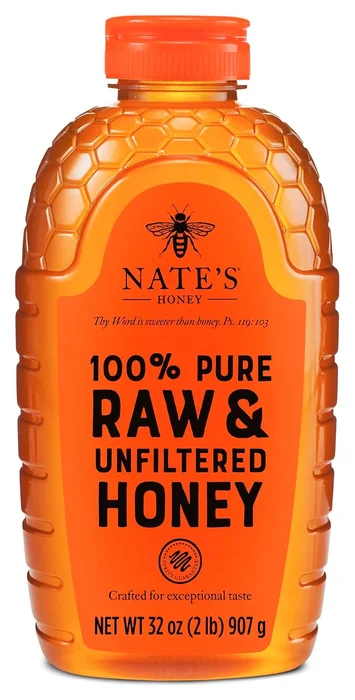
None of the capsules sold through these videos lists honey consistently, and nobody can tell us who actually fills the marketplace bottles carrying the name, so none of them gets a link here. If the spoonful in the video made you want honey in your pantry, we would point to an ordinary jar with a one-word ingredient list: Nate’s 100% Pure, Raw & Unfiltered Honey, 32 ounces, from the brand previously sold as Nature Nate’s, the name Amazon’s product details still show as manufacturer. Per its label, “Ingredients: Honey,” 17 grams of sugar per tablespoon, gently warmed for pouring, with a no-honey-for-babies warning.[11] It will sweeten your tea, and that is the whole promise: it is food, not a memory product.
On October 9, 2026 the listing (ASIN B00CMQD3VS) was priced at $14.47 and in stock, with Amazon.com as both shipper and seller and an average of 4.7 stars across 63,179 ratings. Amazon marks it non-returnable for food-safety reasons.[11]
See it on Amazon →Plain link: amazon.com/dp/B00CMQD3VS. As an Amazon Associate, Mind Vitality News earns from qualifying purchases. Price, stock and seller change; check the listing before ordering.
Where this came from
- Direct fetch of four websites each presenting itself as the official MemoHoney site, plus one honey-trick sales page for a different memory capsule: ingredient lists, dosing, badges, review counts, price tiers, guarantee and FAQ wording, footer disclosures and outbound links, as displayed Oct 9, 2026. Deliberately not linked.
- NBC Chicago (NBC 5 Responds). Better Business Bureau warning on deepfake videos promoting honey-based supplements; recurring-charge and refund complaints. Published Jun 30, 2026. Read Oct 9, 2026; not hyperlinked because the article’s web address spells out the ad claim.
- USDA FoodData Central. Honey, SR Legacy FDC ID 169640: carbohydrate, sugars, fructose, glucose, water, protein, potassium, vitamin C per 100 g; tablespoon = 21 g. Retrieved Oct 9, 2026. fdc.nal.usda.gov
- Bogdanov S, et al. Honey for nutrition and health: a review. Journal of the American College of Nutrition, 2008;27(6):677–689. PMID 19155427. pubmed
- Othman Z, et al. Improvement in immediate memory after 16 weeks of tualang honey supplement in healthy postmenopausal women (102 women, 20 g/day). Menopause, 2011;18(11):1219–1224. PMID 21926932. pubmed
- Mysonhimer AR, et al. Honey added to yogurt with a probiotic strain: randomized crossover design, 66 healthy adults enrolled; no between-condition difference in mood or in a spatial-reconstruction cognition task. Journal of Nutrition, 2024;154(8):2396–2410. PMID 38830472. pubmed
- Zamri NA, et al. Honey on brain health: a promising brain booster (review of 34 original studies, mostly animal). Frontiers in Aging Neuroscience, 2023;14:1092596. PMID 36733498. pubmed
- Nakhaee S, et al. Cinnamon and cognitive function: a systematic review of preclinical and clinical studies. Nutritional Neuroscience, 2024;27(2):132–146. PMID 36652384. pubmed
- Smith MA, Riby LM, Eekelen JA, Foster JK. Glucose enhancement of human memory: a comprehensive research review of the glucose memory facilitation effect. Neuroscience & Biobehavioral Reviews, 2011;35(3):770–783. PMID 20883717. pubmed
- U.S. Food and Drug Administration. Questions and Answers on Dietary Supplements (FDA does not have the authority to approve dietary supplements before they are marketed). Content current as of Aug 27, 2026. fda.gov
- Amazon.com listing for Nate’s 100% Pure, Raw & Unfiltered Honey, 32 oz, ASIN B00CMQD3VS: label images (ingredients, Nutrition Facts, infant warning), price, stock, seller, rating and return status as displayed Oct 9, 2026.
- National Institute on Aging (NIH). Cognitive Health and Older Adults: sleep, activity, blood pressure and SPRINT MIND, medicines, supplements. Reviewed Jun 11, 2024. nia.nih.gov
- National Institute on Aging (NIH). Memory Problems, Forgetfulness, and Aging: correctable causes and unproven memory products. Reviewed Nov 22, 2023. nia.nih.gov